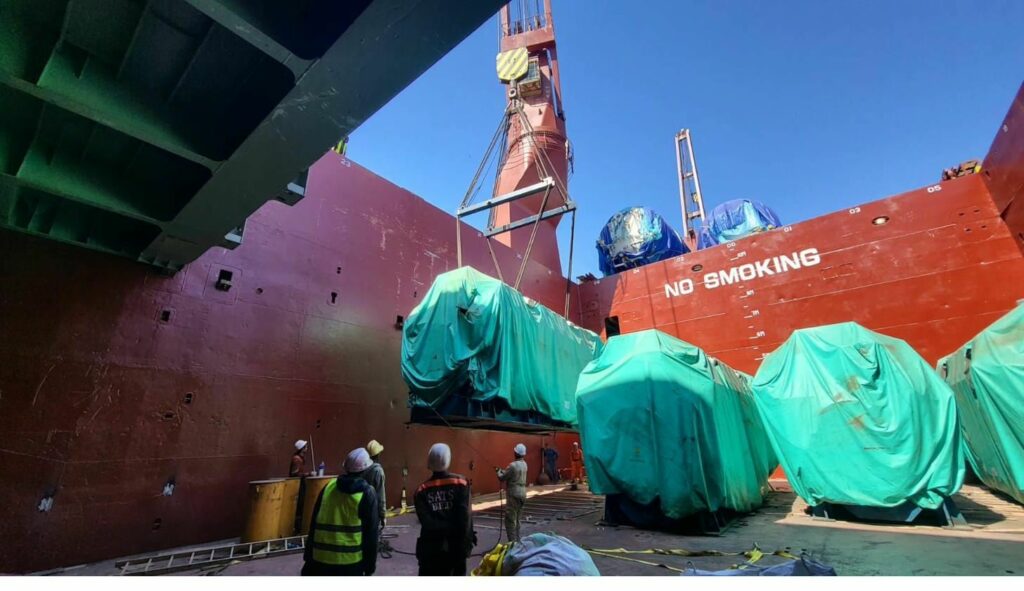
Heavy lift refers to the transport of exceptionally heavy cargo, while oversized transport concerns goods whose dimensions exceed standard limits — width, height, or length. In practice, heavy lift in Africa involves industrial modules, transformers, mining equipment, or complete structures. These operations require specific resources: high-capacity cranes, low-bed trailers, and above all, rigorous transport engineering.
Yes, these are essential steps in any heavy lift operation. Before any movement takes place, our engineers carry out a route survey: checking passage dimensions, bridge capacity, turning radii, and overhead obstacles. In addition, we prepare detailed lifting plans defining the equipment, lifting points, and critical phases. This preparation is key to the success and safety of the operation.
There is no theoretical limit: we adapt the resources to the load. Whether for a few dozen tons or cargo weighing several hundred tons, we mobilize the appropriate equipment — mobile cranes, gantries, and self-propelled modular trailers. However, beyond the equipment itself, it is the coordination between transport, lifting, and port supervision that makes the difference on the most complex operations.
Port unloading is a critical phase in heavy lift operations. Our teams supervise the operation on site: coordination with the port authority, verification of port lifting equipment or mobilization of dedicated cranes, securing of the area, and control of each phase. This service is also closely linked to our maritime agency activity,which manages the port call of the vessel carrying the cargo.
Yes, we manage oversized transport through to final delivery, including to remote sites. This includes obtaining exceptional convoy permits, organizing escorts, managing any necessary road adjustments, and coordinating with local authorities. This service naturally integrates with our project management offer.To assess your operation, contact our team:.